History of Satta Matka
History of Satta Matka is an informational and educational reference page explaining the historical development, commonly used terminology and record formats associated with Satta Matka and Satta Matka Result records.
This website does not provide betting, wagering, gambling services, predictions or guaranteed outcomes. The information presented here is intended for educational, informational and historical reference purposes.
History of Satta Matka
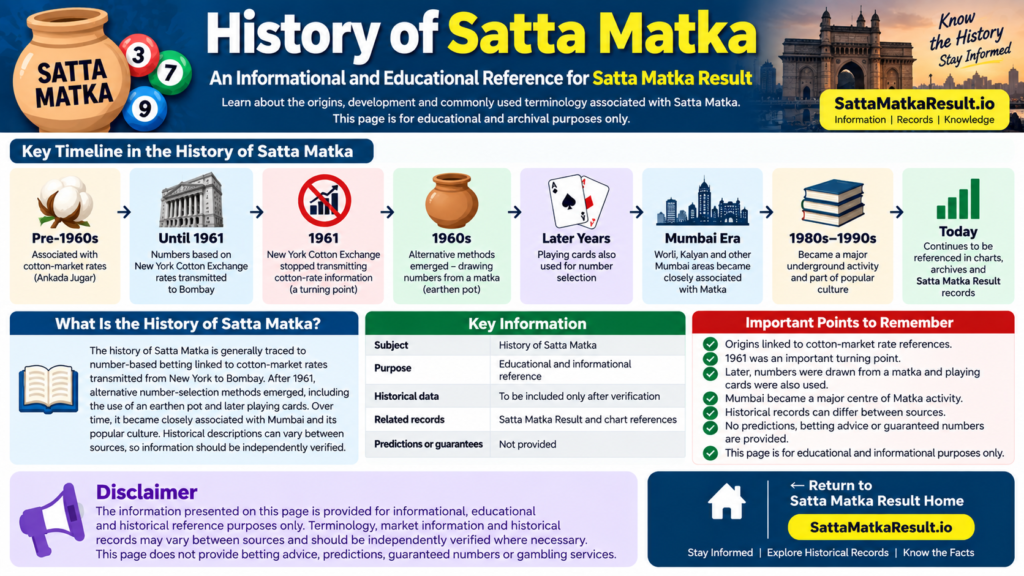
The history of Satta Matka is generally traced to number-based betting associated with cotton-market rates transmitted between the New York Cotton Exchange and the Bombay Cotton Exchange. Public historical accounts describe this early form as being associated with the term “Ankada Jugar” before the later development of matka-based number selection.
In 1961, the New York Cotton Exchange stopped transmitting the cotton-rate information used for the earlier system. Historical accounts describe this change as an important turning point, after which alternative methods of generating numbers were introduced. These included drawing numbered slips from an earthen pot known as a matka and, later, using playing cards.
During the 1960s, Satta Matka became increasingly associated with Mumbai. Historical accounts identify Kalyanji Bhagat with the development of Worli Matka and Ratan Khatri with the expansion and popularisation of another major matka operation. The subject subsequently became closely connected with Mumbai’s mill areas and popular culture.
By the 1980s and 1990s, historical reporting describes matka as a significant underground gambling activity in Mumbai. The scale and organisation of the activity changed over time as law-enforcement action and other forms of gambling affected the traditional market.
Today, the historical terminology associated with Satta Matka continues to appear in publicly available charts, archives and Satta Matka Result references. However, historical descriptions and records can differ between sources and should be independently verified.
Key Information
| Topic Reference | Information |
|---|---|
| Subject | History of Satta Matka |
| Early association | Cotton-market rate references transmitted to Bombay |
| Important development | Alternative number-selection methods emerged after 1961 |
| Mumbai connection | Worli and other Mumbai areas became associated with the history of Matka |
| Historical records | To be included only after verification |
| Predictions or guarantees | Not provided |
Historical data note: Historical descriptions can vary between sources. Specific dates, names and records should be independently checked against reliable references before being treated as confirmed historical information.
Major Historical Developments
Early Cotton-Market Connection
Early accounts connect Satta Matka’s development with betting based on opening and closing cotton-market rates transmitted from New York to Bombay. This system provided the numerical basis for an early form of the activity.
The 1961 Change
The discontinuation of the relevant cotton-rate transmissions in 1961 created a need for alternative methods of producing numbers. Historical accounts describe the subsequent use of slips placed in a matka and later playing cards.
The Mumbai Matka Era
During the 1960s, Mumbai became an important centre of Matka activity. Historical accounts associate Kalyanji Bhagat with Worli Matka and Ratan Khatri with the development of another influential Matka operation.
Growth and Popularity
Matka became particularly associated with Mumbai’s working-class and mill areas. By the later decades of the twentieth century, it had become a prominent part of the city’s underground gambling culture and was also referenced in popular culture.
Later Changes
Law-enforcement activity, changing gambling habits and the emergence of other forms of betting contributed to changes in the traditional Matka business. Historical sources describe the 1980s and 1990s as a period when the activity reached a particularly high level of prominence.
Historical Satta Matka Records
Historical Satta Matka records may include market names, dates, numerical records, terminology and archived result references. Such information can be useful for understanding how the terminology and record formats developed over time.
However, historical records are not necessarily identical across all sources. Any historical Satta Matka Result data should therefore be independently checked before being presented as verified information.
How Satta Matka Terminology Developed
The terminology associated with Satta Matka developed alongside changes in the way numbers and records were generated. The word matka is associated with the earthen pot that was used in historical number-selection methods.
- Early terminology was associated with number-based betting and cotton-market references.
- The term “matka” became associated with the use of an earthen pot for drawing numbers.
- Playing cards were later used as another method of generating numbers.
- Terms such as open, close, jodi and panna became part of commonly discussed record formats.
- Modern websites may use historical terminology differently, so source context is important.
Related Satta Matka Chart Pages
Related Satta Matka Result Pages
Frequently Asked Questions About History of Satta Matka
What is the history of Satta Matka?
Historical accounts trace the early development of Satta Matka to number-based betting associated with cotton-market rates transmitted to Bombay. The system later evolved into other forms of number selection, including the use of an earthen pot and playing cards.
When did Satta Matka become associated with the term Matka?
The term became associated with the use of an earthen pot for drawing numbers after the earlier cotton-market-based system changed. Historical sources place important developments in the early 1960s.
Why is 1961 important in Satta Matka history?
Historical sources identify 1961 as an important turning point because the New York Cotton Exchange stopped the transmission of the cotton-rate information that had been used in the earlier system.
Who were Kalyanji Bhagat and Ratan Khatri?
Historical accounts associate Kalyanji Bhagat with the development of Worli Matka and Ratan Khatri with the expansion of another major Matka operation during the 1960s.
Why is Mumbai important in the history of Satta Matka?
Mumbai became an important centre of Matka activity, particularly around areas associated with the city’s textile mills and commercial districts. The subject later became part of Mumbai’s popular and cultural history.
Are historical Satta Matka records always consistent?
No. Historical descriptions, dates and numerical records can differ between sources. Information should therefore be independently verified before being treated as confirmed historical data.
Does this page provide Satta Matka predictions?
No. This page provides historical and educational information only. It does not provide predictions, betting advice, guaranteed numbers or recommendations.
Explore SattaMatkaResult.io Profiles
Disclaimer
The information presented on this page is provided for informational, educational and historical reference purposes only. Terminology, market information and historical records may vary between sources and should be independently verified where necessary.
This page does not provide betting advice, predictions, guaranteed numbers, recommendations or encouragement to participate in gambling or wagering activities.
← Return to Satta Matka Result Home